
The Annual Youth Virtual Forum, organised by Transform Health’s Youth Initiative, is one of the clearest examples of what youth engagement looks like in practice. Across its 2025 and 2026 editions, the initiative has moved deliberately from introducing young people to health data governance concepts toward equipping them to engage policymakers, interpret legislation, and drive advocacy in the countries where it matters most.
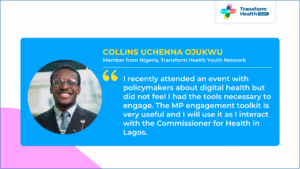
The 2026 Forum built on the momentum created the year before, by shifting from foundations to mastery. Participants deepened their ability to read legislation, map data governance regulatory entry points, identify institutional decision-makers, and translate community experience into policy language.
Across both forums and the six-country assessment, three pathways for youth-led advocacy emerged as the most actionable:
-
- Legislative engagement: arriving at policymaker meetings with a clear understanding of HDG legislation in their country, the key institutional decision-maker, and a specific, bounded advocacy ask rather than a general position
- Accountability and oversight: identifying where data governance safeguards are weakest, building coalitions, and creating constructive pressure for transparency and rights-based implementation
- Public narrative through #WheresMyData: making health data governance accessible to communities who experience its effects every day, turning technical policy into a public conversation that travels through local languages and trusted channels
What This Moment Calls For
Our youth engagement assessment surfaced a consistent finding across all countries: young people are eager, capable, and committed to shape digital health systems towards Universal Health Coverage.
They have grown through this initiative, built meaningful peer networks, and contributed genuine expertise. What they are asking for now is not more training, it is co-leadership: formal seats in decision-making bodies, roles in shaping work plans from the outset, and accountability mechanisms that close the loop between their input and coalition outputs.
For policymakers and health system leaders, the opportunity is equally clear, invest in youth participation at the design stage, not after frameworks are finalised. Embed youth voices in advisory structures. Fund the technical literacy that turns participation from symbolic to substantive.
The generation that grew up with digital health is ready to help govern it as well. The progress made through our youth forums and across six national contexts is proof that with the right investment in capacity and access, youth do not just show up to these conversations, they advance them.
Join our next Youth Forum as we discuss how youth are shaping digital health policies for UHC