

Reflections from a delegate-led discussion co-hosted by Transform Health and Medic at the Skoll World Forum, Oxford — 22 April 2026
______________________________________________________________________________________________________________
At the 2026 Skoll World Forum, Transform Health and Medic led a discussion exploring why so many digital and community health programmes struggle to scale sustainably, and what it will take to embed them in country systems beyond donor support. Mathilde Forslund, CEO of Transform Health, opened the session with co-hosts Shreya Bhatt and Andra Blaj, Co-Executive Directors of Medic. Participants included representatives from organisations working on or investing in digitally enabled community health across LMICs, as well as community health workers and the civil society organisations representing them.
The barriers are political, not just technical
Participants agreed that the main barriers to the adoption at scale of community digital health initiatives are not technical alone but structural and political: donor dependency without fiscal transition planning, weak integration into national digital health architectures, limited government capacity, unclear institutional ownership, failure to budget recurrent costs, and fragmented governance and interoperability. Many also felt that solutions are still not being designed with the end user and are not adequately responding to the local context. None of these diagnoses are new. What was new was the convergence on what to do about them. Sustainability depends on building ownership from the start, anchoring programmes in legislation, budgets and institutions, and making the economic case so that ministries of finance, not only health, see the return.

Mathilde Forslund, CEO of Transform Health, opening the session.
What works on the ground
Manasseh Gihana Wandera, Executive Director of the Society for Family Health Rwanda, highlighted the importance of government commitment backed by legislation, and described a franchise model in partnership with the Ministry of Health that has digitised 60 health centres and 350 health-posts. Rwanda’s regulation is concrete and includes patient rights, data privacy, in-country data hosting and reporting. “A big pillar is to have the regulation in place,” he said, but “the biggest challenge is uptake,” shaped by infrastructure, data, electric power, as well as the right skills and competencies. Most of the challenges are sociopolitical, not technical.
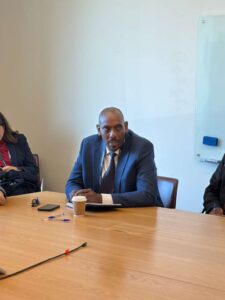
Manasseh Gihana Wandera, Executive Director, Society for Family Health Rwanda.
Surviving political transitions
Sustaining digital community health through political transitions requires more than goodwill. It requires policy and legislative frameworks that outlast administrations, strong national coordination, technical teams that remain in place, and evidence that digital systems improve outcomes and save money. Julius Mbeya, Co-CEO of the Lwala Community Alliance, captured the practical answer: spending can be reduced but cannot go to zero. Resource specific budget lines are critical. And technical teams who stay through changes of government need the mandate and support to drive forward government commitments.
This is the institutional anchoring Transform Health’s white paper, Digital Transformation for Universal Health Coverage, calls for — developed with Medic, Living Goods, Terre des Hommes, Village Reach, D-tree and TIP Global Health. Not bolted-on tools, but a digitally enabled community health system, supporting a community health workforce, empowered, supervised, compensated, equipped with the right digital tools for their context, and embedded in the national health system. To achieve this at scale requires government leadership and commitment, backed by policy and regulatory frameworks that will mandate strong national coordination and resource allocation. Kenya’s Community Health Act and Digital Health Act are good examples of such frameworks.
Regional frameworks, country adoption
Participants agreed that regional frameworks can help countries adapt good practice more quickly, but country-level adoption depends on contextualised policies, public and political demand, and practical guidance for implementation. Africa CDC is well placed to contextualise and accelerate continental guidance. Regional and global instruments work best when they circulate learning across countries rather than dictate one model. While regional and global instruments are important in establishing guidelines, participants felt the key to the successful digitalisation of community health lay at the national level. National frameworks developed with communities, led and implemented by governments and responding to the exigencies of context, is the most effective pathway to change.
Where this leaves us, and where investment counts most
The next steps map directly onto the framework Transform Health and partners are operationalising: strengthening institutional anchoring, building capacity, demonstrating cost savings and public value, supporting country-specific policy frameworks, and using regional bodies such as Africa CDC to capture and share lessons countries can take forward. The event closed with a call from participants for an integrated approach combining technical design with policy influence, advocacy and cross-sector engagement, so that community health becomes a public priority and not just a health-sector project.
For donors already investing in community health and digitally enabled interventions in LMICs, this is where additional support delivers the highest multiplier. What protects investments through fiscal cycles, donor exits and political transitions is the legislation, the budget lines, the institutional anchoring, the political demand, and the evidence. These frameworks de-risk additional investment in digitally enabled community health projects and increase the chances of national adoption at scale. Transform Health and Medic, with our coalition partners, will work with existing initiatives and coalitions, to contribute to the wider engagement on the digital transformation of community health. Our efforts support that of partners such as the Community Health Impact Coalition (CHIC) who held an event alongside Skoll World Forum to take stock of the rapidly evolving intersection of community health workers (CHWs) and AI. Our aim is to add value to such initiatives by addressing national governance frameworks. The sustainability of community health is, in the end, a political question. We need to address this collectively to succeed.